Wednesday, October 13, 2010

Thursday, October 7, 2010

Our sixth week in review: 10/4-10/8

Another four day week for us because today (Friday) is our big field trip to the Pennsylvania Renaissance Faire!  <insert happy dancing>  We are all set to enjoy the shows, demonstrations, food and the gorgeous weather----pictures will be up over the weekend :)

It was a pretty good week with only one FAIL...

Math
Chugging along with percents.  I've been making her do problems backwards and forwards, solving using either using decimals or fractions.  Daisy became much quicker by the end of the week at deciding which method to use.  There is a light at the end of the percent tunnel ;)  No fun math this week due to the Faire.

Science
If you're a good blog reader, you'll have noticed that I've been putting up separate posts for labs we've been doing (that's ok, go check now...)  This week we continued with Chapter 3 (Physical Science Connections) in CPO Earth Science:

(Monday) Section 3.3 Density and Buoyance, see separate Density Column demo blog post

(Tuesday) Physics Connection about the science behind hot air balloons plus the chapter activity (modeling radiation of heat energy from the Sun to the Earth).  The pictures didn't turn out well for the activity, alas.

(Wednesday) Daisy took the Chapter 3 assessment (aka test) orally.  So far, no problems at all with retention.  I love CPO.

(Thursday) We began Chapter 4: Water and the Water Cycle by reading and discussing 4.1 Water on Earth's Surface and started Investigation 4A: The Water Cycle.  This lab requires 4 days of observations so she'll be checking the set-up through the weekend.   As a preview:


(And yes, that is a telescope in the corner of the home office.)

History
This week we covered the 1st and 2nd intermediate periods (Ancient Egyptian World chapters 8 and 10), hieroglypics (AEW chapter 4,  Dig magazine March 2010 issue, Write Like an Egyptian through the UPenn Museum), the Rosetta Stone (The Riddle of the Rosetta Stone), and daily life of regular Egyptians (AEW chapters 9, 12, 17, 19, 23).   Some additional books were used for visual reference.


We also made Egyptian flatbread from Great Ancient Egypt Projects You Can Build Yourself, which was our FAIL of the week.  Blech!  They would have been greatly improved by more oil or salt.  Or sugar and egg!


Grammar
Finished up pronouns with indefinite pronouns and the always-fun double negatives.  Daisy took the test to end the week.

Literature
As shown above, she read The Riddle of the Rosetta Stone for history.

We moved further into poetry, studying alliteration, assonance and consonance using
We had a lot of fun reading the selections from both books aloud, identifying the various sounds and doing the exercises in Figuratively Speaking.  I have to dig out all of our poetry books from the attic, basement, and various kids' bookcases.

French

What have I gotten myself into?  One day we listened to the audio selection 10 times and still could not understand how to say one thing as the speaking was moving waaaaay too quickly.  Older Sister rescued us when she was home!  I like how this text is arranged, with a dialogue (also on CD), with vocab and grammar information, followed by a few exercises.

We're reviewing the previous day's lesson and audio selection each day before moving onto the new information.  Daisy's having a good time and so far I haven't confused German pronounciation too much with the French... Next week she's going to start writing some exercises.  I've also decided to purchase the CD containing additional exercises and tests, to make sure she (and I) are really understanding the French.  My eventual goal is for Daisy to comfortably pass out of French 1 as a high school freshman.

Other
We spent a long time reading the PA RenFaire website!  We'll be attending the special elementary school day (geared for grades 3-6)---here's the information about the day.

Best of the Week:  fun with poetry!

Worst of the Week: that awful flatbread.  Yuck.  The activity book is fabulous, btw, but probably geared to slightly younger than Daisy.

Looking ahead to next week: a ballet performance on Sunday (a special in-studio event tied with a fundraiser at a schmancy restaurant downtown), Girl Scouts at our house Tuesday night (I've got to get those badge activities planned out....), a shortened day on Wednesday (Older Sister will be finished at 11:30 after taking the PSAT), finishing up one lab, doing another AND an activity from one of the skill & practice sheets that I'm turning into a lab-------watch for separate blog posts!  Whew!

And will Older Brother get an application or two submitted.....??????  Will I have hair left?????  Will there be homebrew left in the basement?????  Stay tuned!

Thrifty Thursday---coupon plans and a free rain barrel!

In an attempt to regain at least a part of my pre-homeschooling life, I'm going to post a "my frugal life" update each Thursday.  Why Thursday?  Well, that's when the grocery chains update the online ads for the next cycle, which begin on Fridays, AND the day the local free paper is available.  Some weeks the local paper is a great source for coupons! 

I just checked the online coupon previews and the Smart Source for this Sunday doesn't contain anything that would make me go check the newspaper boxes downtown.  The ads for Pathmark and SuperFresh are equally disappointing.  The turkey promo doesn't start until next week, bummer.  ShopRite isn't starting until 10/17!

Acme's ad isn't up yet but online chatter shows a ConAgra buy $25/get $10 oyno.   I have 3 gallons of Wesson canola oil and about 40 boxes of Swiss Miss hot cocoa (yum, mocha!) for the kids from last winter's ConAgra fest---------I rolled those cats all week long, spending maybe $5 total out-of-pocket including non-ConAgra items (veg, fruit, dairy).  That was a fun week!  But this time, nothing is jumping out at me.  The sale prices on items we'd use (Wesson, Pillsbury flour, Pam spray) seem high, and without good coupons the price spread between the regular shelf price and the sale-price-after-coupons isn't large enough to work out to free items.  But I've been wrong before, so I'll reserve judgement until reports come back tomorrow from early Acme shoppers.

Last night I was one of 25 lucky city residents to receive a free 55gal rain barrel!  A few weeks ago, an email was sent from the city advertising a free storm water management seminar through the county extension service.  The first 25 residents to register would receive a free rain barrel, with others receiving info on how to make one themselves.  I called within 45 minutes of the email being sent and was 24 of 25!!  I'm so happy I decided to look at email that day during lunch as I've been wanting a rain barrel for YEARS.   I'd love to have several in the back, one by the hops and herbs and two connected in series by the veggie garden, just for starters.

Check out this beauty:


We'll put it up on cinder blocks and use the bottom outlet for a hose.  The midsection outlet will be used eventually to connect this barrel to another.  We'll chose one of the top outlets for an overflow hose to direct excess water away from the house.  The top of the barrel is a fixed lid with three screened holes---no insects to worry about.

There's only about 4 weeks left for this rain barrel season....but we'll be well-equipped for next spring!

Wednesday, October 6, 2010

Wordless Wednesday: A hands-on day in two pictures

First, a recreation of Zoser's angled (abandoned) pyramid in chocolate chip cookie, complete with chambers and shafts:


Second, getting our geek on (radiant heat demo):

Monday, October 4, 2010

Density Column (Chapter 3, section 3)

The teacher's guide for CPO Earth Science is a wealth of information for the parent-as-teacher.  Each chapter section lists activites to motivate the student(s), explore, explain, extend and assess the topic at hand.  In section 3.3, the extension activity is to create a density column.

Given several liquids, the student is to predict which liquid will be the most dense and which will be the least dense.  When the liquids are poured into a graduated cylinder or other container, they will order themselves from least dense (top) to the most dense (bottom).

Daisy chose these household liquids: fake pancake syrup (don't judge--Costco was out of the real stuff), dark Karo corn syrup, lemon juice, canola oil, and water.  She predicted the liquids would order as oil, water, lemon juice, syrup and Karo. 

We used a large test tube to form the column.  It and other goodies were found in a box of supplies Older Brother had used to practice for a Science Olympiad event over the years.  Unfortunately, no graduated cylinder appeared so we pulled out the trusty medicine cup.


She carefully poured approximately 15 ml of each liquid into the test tube in order of lightest color to darkest color.  Here the Karo is making its way down the test tube:


We let everything settle while we ate lunch and ran to the grocery store.

An hour later:

Not bad!  Daisy had thought that the lemon juice would be separate from water.  I had her read the label---water, lemon juice concentrate...---"Oh! The water and the lemon juice mixed together!"  You can see the lemon solids suspended in the center of the test tube.  If the test tube was to sit undisturbed overnight, the solids would probably settle into a more defined layer instead of a blob.

Do some science!

Sunday, October 3, 2010

Adapting the density cube lab (Investigation 3B: Density)

Investigation 3B: Density----"Why do some objects float in water, while others sink?"

Materials to be adapted:
displacement tank
density cubes (steel, wood, aluminum, copper, PVC)
100ml graduated cylinder

A displacement tank is a large plastic beaker with a spigot on the side.  When an object is placed into the full tank, water will flow out the side to be collected in a beaker.  The water is then measured in a graduated cylinder to determine the amount displaced by the object------volume displaced=volume of the object.

I did not want to try to rig up a displacement tank so I decided we'd just measure displacement by the use of a graduated cylinder------measure the water level in the graduated cylinder, place the object in the cylinder, measure the new water level to determine the volume of water displaced by the object.

Unfortunately we didn't have a graduated cylinder.  Ooops. I used an old medicine dosing cup with milliliter markings to make a juice glass into a temporary graduated cylinder:
Rough measurements to be sure but the purpose of the lab was to introduce the concept of density.

Density cubes were to be used during the first portion of the lab.  The cubes are of the same size but are made of different materials.  Students then do not focus on size/shape of the objects, but rather on the behavior of the various materials.  As much as I would have loved to use density cubes (see the Nasco catalog here), I couldn't justify the expense for a single lab.  We then turned to regular-shaped objects found in the house-----a Jenga block, a magnet, a die, and a cube of brass Lab Assistant cut from a larger bar.  The regular (either cubic or rectangular prism) shapes would enable Daisy to easily determine the corresponding volumes by length x width x height.  I couldn't find a bar magnet, so I substituted the circular one and held a quick review of the volume of a cylinder.


For the first section with regular-shaped objects, she was to predict whether each object would sink or float.  Then she found the mass of each on our balance (food scale, thankyouverymuch), used a ruler to determine the volumes, calculated the density, and then plopped each into our "graduated cylinder" to see if it would sink or float.  She actually thought the die would be neutrally buoyant--would neither sink nor float--and was disappointed that it did sink.

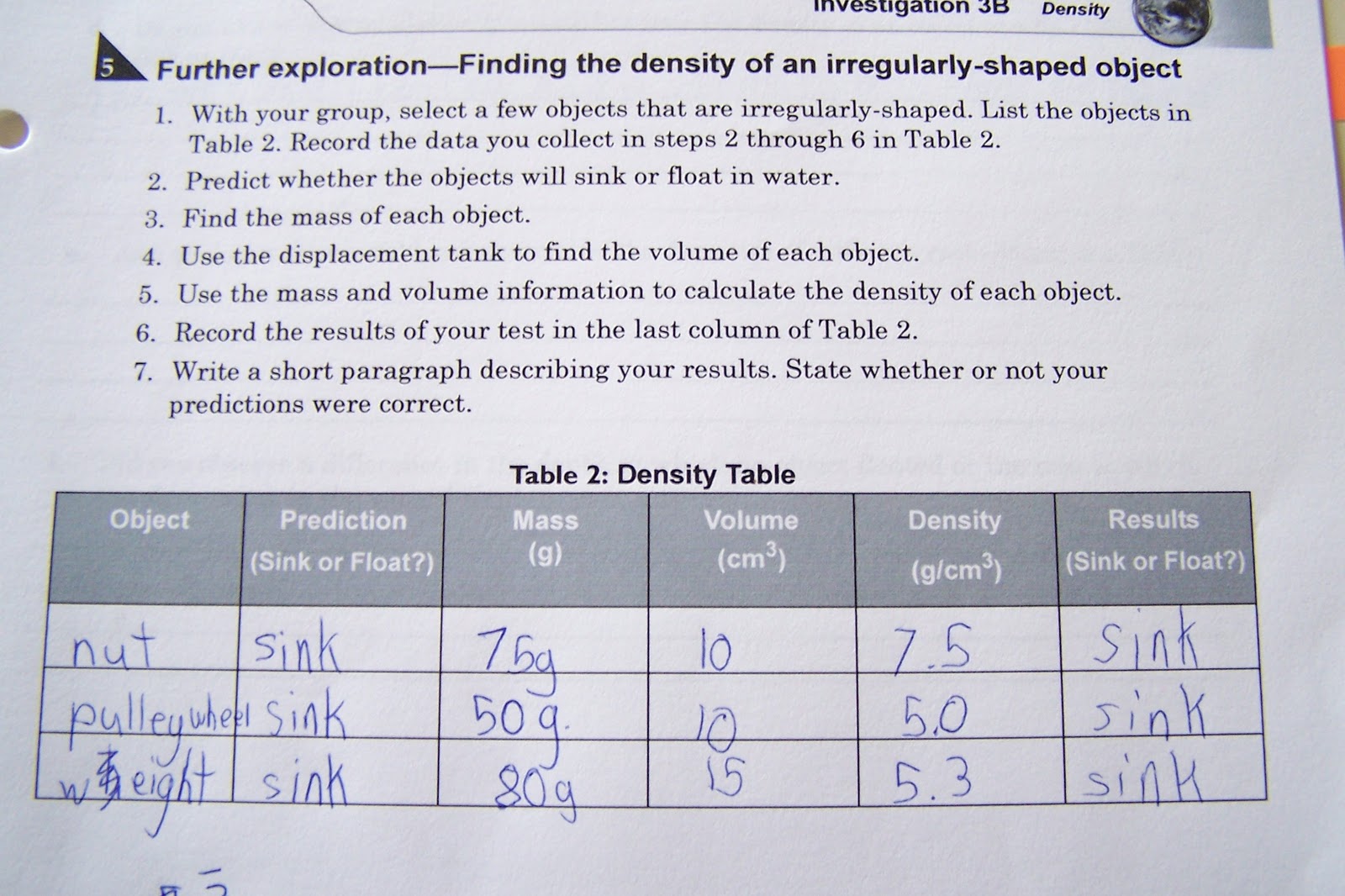
The next portion involved determining the density of irregular objects.


You can view the data table below.  The volume of each was determined by the displacement method.


Carefully placing objects into the graduated cylinder:


It was a bit tricky removing some objects from the bottom of the graduated cylinder!


Thanks for reading about another fun, hands-on lab with CPO Earth Science!

Friday, October 1, 2010

Adapting the convection lab (Investigation 3A: Convection in Earth's Atmosphere

Of all the labs for CPO Earth Science, 3A: Convection in Earth's Atmosphere was the most daunting to contemplate using a homemade system.  The text calls for a "GeoBox" with a special fitted lid that contains two chimneys.  Meet my GeoBox-----an old Rubbermaid box (the size larger than a shoebox), an even older cardboard document box lid that had gone through several moves, and two clear plastic cups left from a party. The other necessary supplies were a tealight candle and a cone of incense, plus a long lighter or fireplace matches and a heat-proof holder for the incense.  We live in a university town with a ready supply of incense LOL:
The ever-resourceful Mike cut out the bottoms of the plastic cups using a Dremel attachment:
Then I inserted the cups into holes cut into the cut-down cardboard lid.  Unfortunately, I inserted them upside down compared to the official GeoBox chimneys, but it still worked just fine.
I attached the lid assembly to the plastic box with packing tape.  The lid wasn't perfectly flat so this helped to create a better seal for the eventual smoke.
As you can see, we needed help from our lab assistant (who was working from home) to keep the lid pushed down.  The smoke wanted to escape out the edges instead of through the left chimney. 
We smartened up and used index card packs to hold down the lid.  I had a hard time photographing the smoke.  If you look carefully at the left chimney, you can see a column of smoke exiting there.  What you cannot see is the smoke re-entering the GeoBox through the right chimney.  The smoke moves from the smoldering incense (cough, cough) toward the candle's warmth, rises as it warms and becomes less dense (exiting), then cools, becomes more dense and sinks back into the box through the right chimney.   The smoke enables one to observe the convection currents in action.
Did you enjoy our geeking-out?